I’m excited to let everyone know: my cookbook is now available to order. Cook with Plants, second volume of my series It’s Only Natural.
How Some Restaurants Are Manipulating Reviews Without You Knowing
I’ve learned a new phrase today: Review Gating. Been over two decades in this industry, I had never heard of this before, so I am a bit embarrassed. Because I feel I should know these things. So don’t feel embarrassed if you haven’t heard the expression either. It’s review gating.
I was in the middle of prep when the restaurant’s phone rang. It was a sales rep from a payment system company. You know the type: friendly, fast-talking, very keen to tell me how their product would “transform my business.” I’ve had these calls before. Usually I’m polite and get back to my chopping board within two minutes.
But this one stopped me cold.
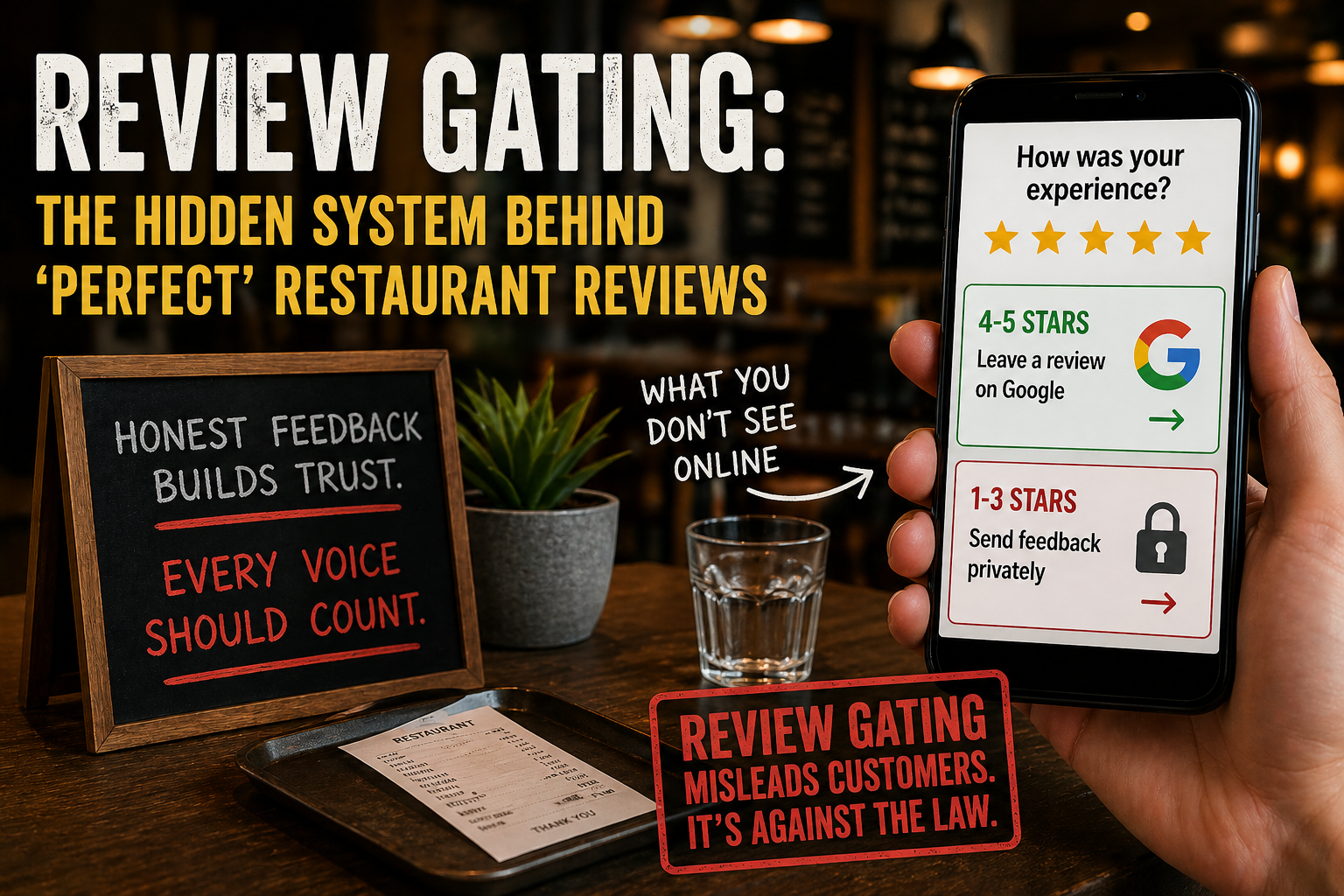
The rep explained that their system doesn’t just take payments. After a customer pays, the system asks them to rate their experience right there and then. Sounds great, right? Fast, easy, more reviews.
But here’s where it gets interesting.
If the customer gives the business four or five stars, they are directed to leave a public review on Google. One click, done, posted publicly.
If the customer gives the business one, two, or three stars, their feedback is diverted to a private form instead. A black hole. It never reaches Google. The business receives it internally, and the unhappy customer’s voice simply disappears. Only the satisfied ones are sent on to leave a public review.
I want you to let that sink in.
I got so angry I could barely stay on the call. I told the rep exactly what I thought of his service and hung up. But before I hung up, he laughed and said, “Why not? Everybody is doing it.”
I immediately went online to check if what he was promising was true. And what I found made me want to give up on this business entirely.
This practice has a name. It’s called review gating. And it is happening right now, in restaurants near you, probably in your town, maybe on your favourite street.
Why It Matters: The Impossible Choice
I’ve been running my kitchen honestly since day one. At Oliveira Kitchen, we have a 4.7 score on Google and a 4.8 on TripAdvisor. In five years of trading, we have fewer than 500 reviews. And we never hired a PR or marketing company. We never had the resources to do that. This is all through hard work and word of mouth.
Every single one of those reviews was earned with sweat, tears, and sleepless nights. They represent real people who sat in our chairs, breathed the air of our dining room, and ate the food we prepared. They are unfiltered and hard-won.
Then I look at the competition. I see businesses racking up 20 five-star reviews in a single weekend. Then I check TripAdvisor, or another local review site, and the picture is completely different. There’s a restaurant near me that opened less than a year ago. On Google, they have 1,700 reviews and a 4.9 rating. On TripAdvisor, they’re sitting at 3.8. Same restaurant. Same food. Same service. You can’t review gate TripAdvisor. That’s why the 3.8 is still there. But you can review gate Google. And that’s exactly what they are doing. I know it. I can see it. But I can’t do anything about it.
The Algorithmic Trap
This isn’t just about vanity; it’s about survival. Google made reviews the engine of modern discovery. Because these businesses are cheating their way to dozens of only good reviews a week, Google’s algorithm identifies them as a “better” or “more popular” business. They remain at the top of the search engine, the single largest factor in bringing customers in. My potential customers never even had a chance to find me because the cheaters are occupying the top spots. I lose the guest before I even get the chance to show them what we do.
The Death of Fair Competition
We can’t compete. We won’t compete. To compete, we would have to cheat like they are doing.
When a system allows for this kind of manipulation, it creates a marketplace where “doing the right thing” is a recipe for failure. They aren’t just cheating you, the customer, by giving you a false impression of their quality. They are making it impossible for an honest business to survive on a level playing field. It isn’t competition; it’s a slow-motion eviction of integrity from our high streets.
That’s not competition. That’s just fraud.
It’s Now Against the Law in the UK
Review gating is no longer a grey area.
Since April 2025, new rules under the Digital Markets, Competition and Consumers Act 2024 prohibit businesses from misleading customers through reviews. That includes suppressing negative feedback or presenting reviews in a way that gives a false impression of what customers really think.
The Competition and Markets Authority is clear that hiding negative reviews or presenting only positive ones in a way that misleads consumers can breach the law. The Competition and Markets Authority now has the power to investigate and fine up to 10% of global turnover for serious breaches, and has already begun enforcement action against misleading review practices.
So no, this isn’t just “clever marketing.” It’s a system designed to mislead customers. And under the new rules, those using this unfair practice are at real legal risk.
How to Spot It as a Customer
Here’s what to look for next time you’re checking reviews before booking somewhere:
Suspiciously perfect scores A 4.9 or 5.0 rating with hundreds or thousands of reviews and almost no critical feedback at all should raise questions. Every real business gets the occasional negative review.
Generic reviews If most reviews say “great food, great service” with no specific details, it may indicate people are being prompted quickly rather than writing thoughtful feedback.
Sudden clusters Large numbers of reviews appearing in a short period may suggest something artificial is going on. A single honest one or two star review could easily be buried under ten or twenty gated five star reviews, becoming invisible to anyone casually browsing.
Unusually high review rates If you do not ask for a review, most customers simply move on with their day. Happy customers in particular are the least likely to leave a review on their own. For them, the experience ends when they pay the bill and leave.
Unprompted reviews tend to come from the extremes. Either someone had an exceptional experience, or a poor one. That creates a natural imbalance where only a very small share of customers leave feedback at all.
In practice, this means the organic review rate in a restaurant is typically very low, often well under a few percent. If a small restaurant suddenly produces dozens of reviews in a short period, it is worth asking how that happened. A 40-seat restaurant can only serve a limited number of people in a week, even with multiple table turns. So if it suddenly gets 50 reviews in seven days, that would require an unusually high proportion of customers to post, far beyond what typically happens organically. That does not prove manipulation on its own, but it is a strong signal that something may be actively driving or shaping those reviews behind the scenes.
What You Can Do About It
Leave your honest review on Google directly. Don’t let a redirect stop you. If you had a bad experience, go to Google and say so. That’s how the system is supposed to work.
Report suspicious profiles. Google has a Business Profile reporting tool where you can flag businesses that appear to be manipulating reviews.
Report it through official channels. The Competition and Markets Authority treats misleading review practices seriously, and concerns can be raised via gov.uk.
And to the Rep Who Called Me
I passed.
Not because I couldn’t use more reviews. Every small business could. But because the customers who walk through my door deserve better than a system designed to silence them if they’re unhappy. And the other honest restaurants out there, the ones working just as hard as I am, deserve a fair fight.
If you’re a customer reading this, your review matters more than you think. Use it honestly. It’s one of the most powerful things you can do to support the businesses that actually deserve your trust.